
As part of our College enrichment programme, students have the opportunity to join the Super‑curricular Group — a dedicated space designed to help them deepen their academic interests and build a strong foundation for future university applications.
Super‑curricular activities go beyond the A level syllabus. They include reading books and articles related to a chosen degree, completing online courses, and engaging with subject‑specific research. These experiences play a vital role in Personal Statements, offering universities clear evidence of genuine subject interest and the ability to pursue independent study.
One of our students, Arjun, tells us about his project:
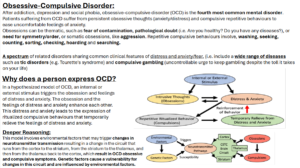
The main focus of my presentation was exploring what OCD (Obsessive Compulsive Disorder) actually is, why it affects so many people, and challenging common misconceptions about it. OCD is often thought of as a single disorder, but it’s actually a spectrum of disorders (e.g. compulsive gambling and tic disorders) linked by distress and anxiety. These obsessive feelings cause ritualised compulsive behaviours, which can temporarily reduce anxiety but reverts to the cycle. On a biological level, OCD is associated with changes in brain circuits involved in fear, decision-making, and habit formation, alongside disrupted neurotransmitter signalling. Furthermore, I had covered different treatments for OCD, including Cognitive Behavioural Treatment (exposure to the obsessive compulsive and then trying to resist the urge to react to it) and Pharmacological Treatment (use of SSRIs, the main drugs used to treat OCD but have side effects, e.g. nausea). After explaining the background of OCD, I then displayed the results of treating mice with OCD using Pharmacological Treatment, which could possibly be used for humans with OCD too.
It has helped me in preparation for my choice of what to pursue/study at university greatly. Learning about the ethical standards in animal research, reinforced the importance of welfare and responsibility for me which strongly influenced my decision to study Medicine at university. Through this research I have strengthened my understanding of research methodology and ethical handling of animals, which heavily links to Pharmaceutical Research. Even studying about how illnesses develop and are treated allowed me to consider pursuing Pharmacology. I also developed a clearer understanding of how certain mental health conditions exist on a spectrum and why this matters for diagnosis and treatment, relating to Public Health. Overall, my super-curricular research has been really rewarding. It gave me the chance to explore different fields such as Medicine, Public Health, etc. and helped shaped my plans of what to study at university. I am deeply thankful to Lisa (Head of Careers) and to Brampton for giving me this opportunity and support throughout my research.